
Busted: The Productivity "Rules" Nobody Should Follow
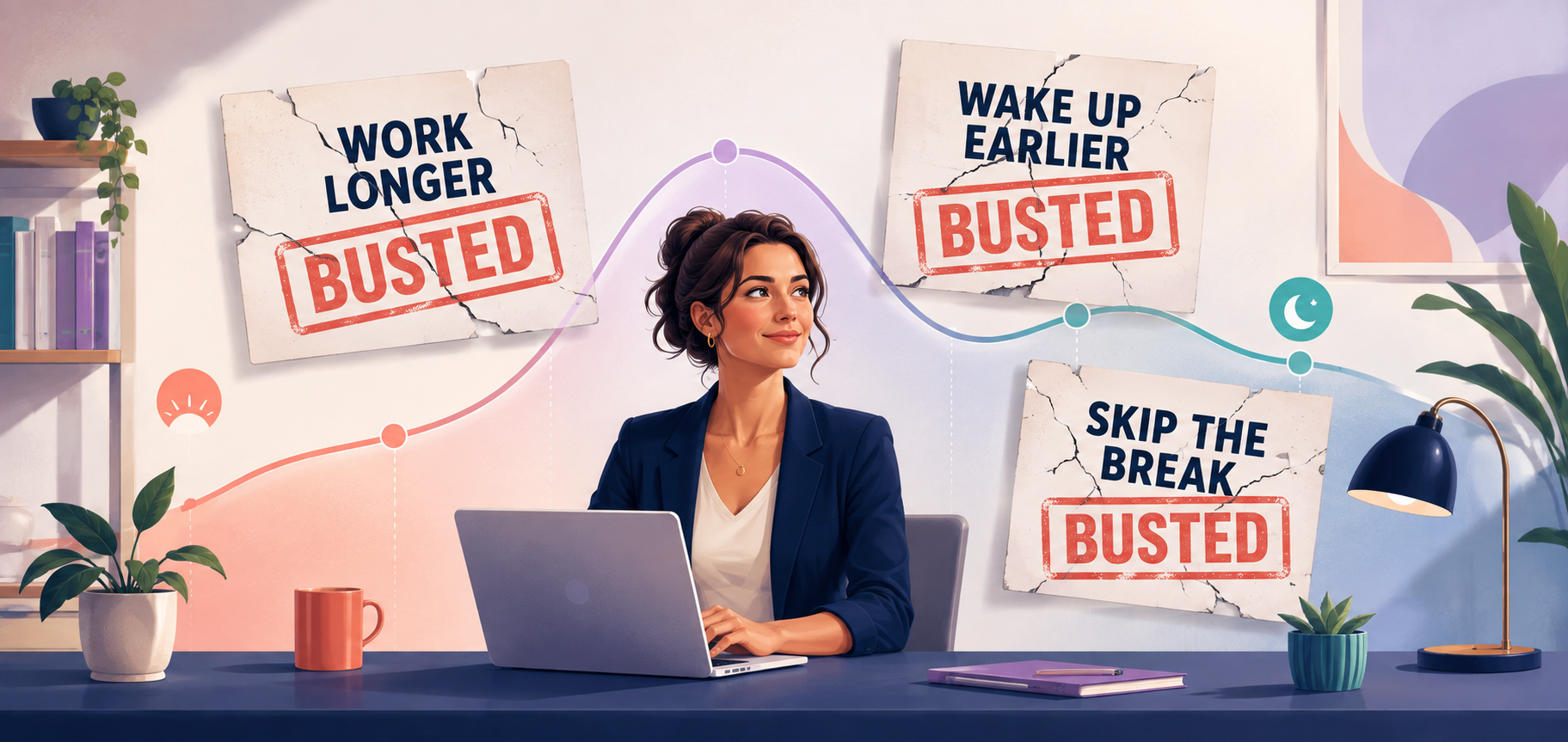
We recently ran a MythBusters series to challenge some of the most common beliefs about productivity and work. Before we get into it, here's a quick introduction if you're new here.
Restore is a workplace platform that helps professionals understand their personal energy and cognitive performance patterns so they can design better workdays. Using an energy assessment, calendar analysis, and optional wearable integrations, Restore gives people and organizations the data-driven insights they need to reduce overload, improve focus, and do their best work at the right time.
Myth #1: Working longer means getting more done.
This one is so embedded in work culture that it almost feels like fact. A study of over 6,500 people found that working more than 55 hours a week is associated with measurably lower cognitive performance on reasoning, memory, and vocabulary. An overworked brain, the researchers found, performs about as well as a brain that is not working at all.
When you work longer hours, you end up borrowing from tomorrow's performance to squeeze more out of today. The most productive people are not the ones logging the most hours. They are the ones who know when they are sharp and protect that time.
Myth #2: “The early bird gets the worm.”
We’ve all heard this one before, but it's only true if you happen to be an early bird.
Research on chronotypes shows that only about 25% of people are natural morning types. Another 25% are night owls, and the rest fall somewhere in between. The majority of the workforce is simply not biologically wired to do their best thinking at 8am. And yet we schedule our hardest meetings, our biggest decisions, and our most demanding work right at the start of the day. For a huge portion of people, that is actually their worst cognitive window.
The early bird does not get the worm. The bird working during their peak energy does.
Myth #3: Taking breaks is a waste of time.
Sometimes stopping feels like falling behind, but the research tells a different story. A meta-analysis of more than 2,300 people found that microbreaks, meaning breaks lasting 10 minutes or less, significantly reduced fatigue and increased energy. For more demanding work, longer breaks were associated with even greater improvements in performance.
Your brain is not a machine. It needs recovery time, especially after periods of intense focus. Taking a break is not falling behind. It is part of doing your best work.
The pattern here is pretty hard to ignore: the way we have been taught to think about productivity is not based on how the brain actually works. Working with your brain instead of against it is not a radical idea; it’s just a smarter way to work.
Restore helps you figure out when you are actually at your best, and then build your workday around that. Whether that means shifting when you schedule deep work, protecting your recovery time, or just understanding your own patterns better, it all starts with knowing how your energy actually works.
Learn more at restoreworklife.com.
Sources: Virtanen et al., Whitehall II Study, American Journal of Epidemiology · Till Roenneberg, chronotype research, Ludwig Maximilian University of Munich · Albulescu et al. (2022), PLOS ONE